
Overview
Since the pioneering research of Anneliese Maier, the reception of the doctrine of indeterminate dimensions has been studied in relation to both individual authors (e.g. Thomas Aquinas, Aegidius Romanus, John of Jandun, Walter Burley) and specific intellectual environments (particularly the Parisian and English traditions). Still missing, however, is a study focused on the Italian context and the Averroist masters of the studium of arts and medicine in Bologna. The project fills this gap by pursuing three main objectives: (i) the study and critical edition of unpublished and little-known texts; (ii) the reconstruction of the intellectual profiles of lesser-known masters; and (iii) the assessment of the distinctive features of this largely unexplored strand of the debate and of its influence on sixteenth-century academic discussions.
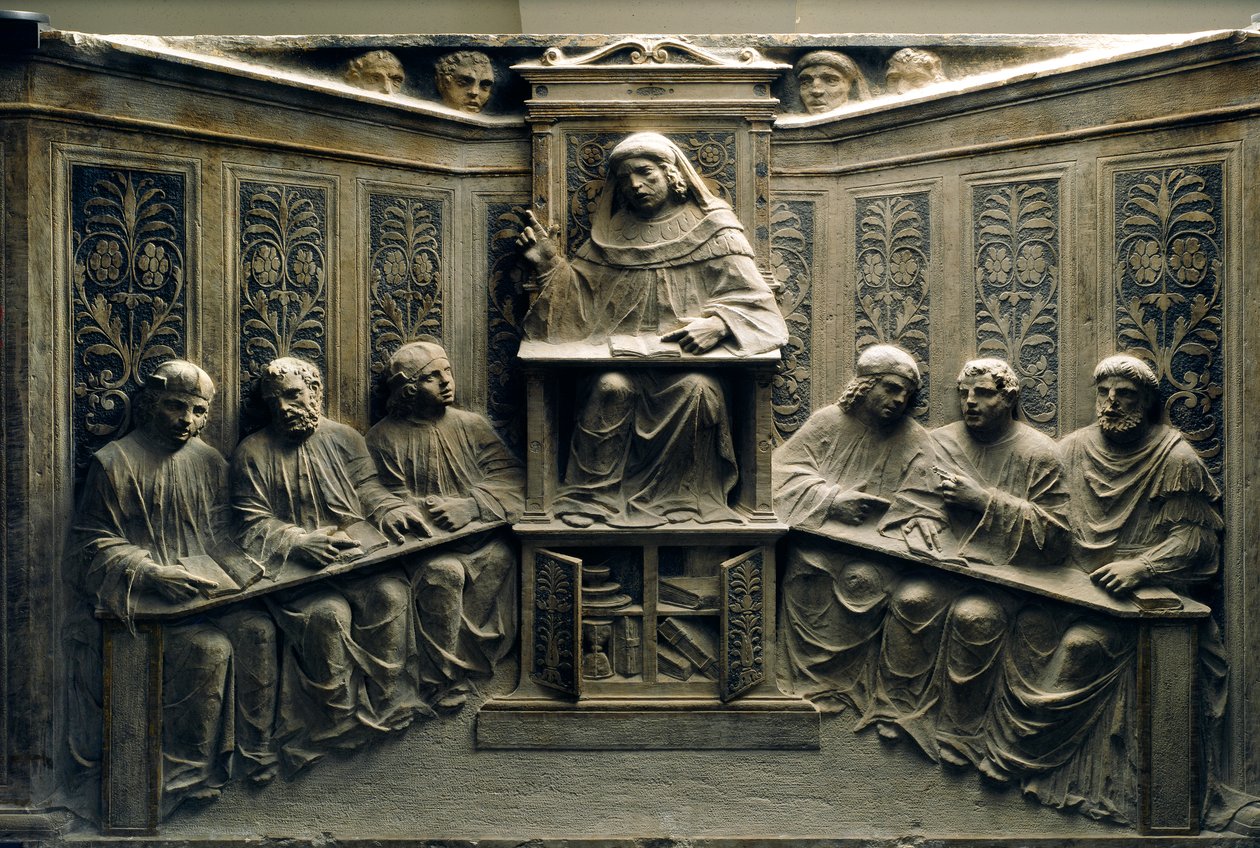
University lecture, bas-relief on the tomb of Pietro Canonici (d. 1502)

Expected impact on Society
As ‘primary’ effects, we expect: (i) to convey the image of a vital, plural, polycentric ‘Middle Ages’, demystifying the humanistic and Enlightenment idea of an ‘intellectual night’; (ii) to correct the perceptual distortion – also widespread – according to which the ‘abstract’ discussions of medieval thinkers would have been uninfluential (if not obstructive) to the emergence of modern, positive and experimental science; (iii) to raise awareness of the richness of documentary resources in the northern Italy area (and of the importance of the work of those who preserve them); (iv) to offer a historical example of the fruitfulness of cultural hybridization (in particular, between Arab and Latin cultures). As a ‘secondary’ or ‘collateral’ effect, we expect to expose the audience to a critical method, which – as Marc Bloch used to say – is also crucial in everyday life, when it happens to collect, compare and weigh evidence.
 matterspacechange.blog